What we found on Marquez Concrete’s old site
Four things that were quietly broken on a Noonday concrete company’s old website, why each one mattered, and what the rebuild did about them.
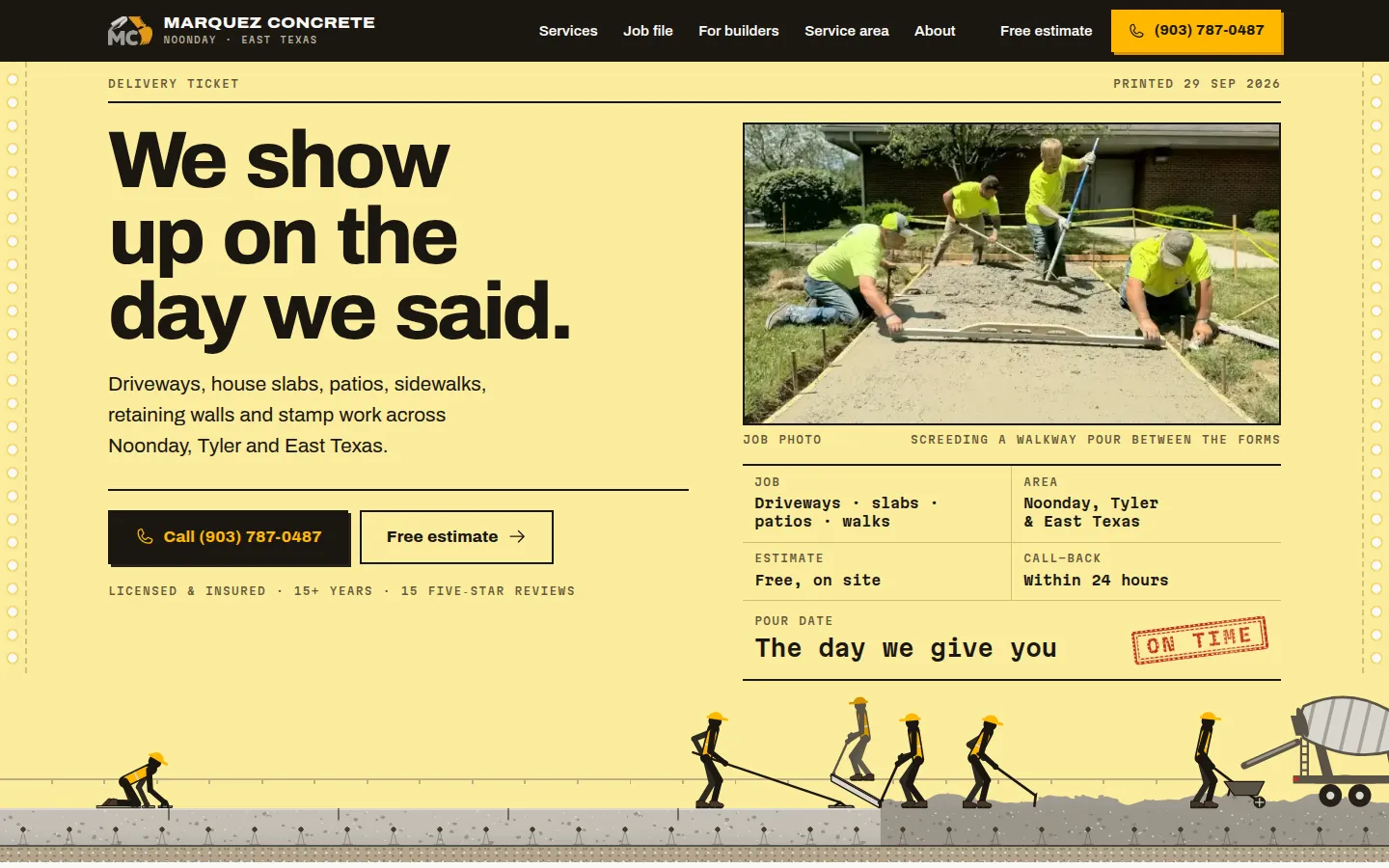
Marquez Concrete pours driveways, slabs, patios, walls and stamp work out of Noonday. It already had a website when we started. Before building anything new, we went through the old one page by page, looking at what sits underneath each page, not just what shows.
None of what we found was visible on the page. The site looked finished. That is exactly why these things are worth writing down: every one of them is easy to miss, and any site can have them.
1. Every page named an address that didn’t exist
Each page of a website carries a canonical tag: a line in its code, invisible to visitors, that tells search engines “this is the real address of this page”. Search engines read it to decide which address to list.
The old site’s canonical tags all pointed at marquez-concrete.com. That domain wasn’t registered: type it into a browser and nothing answers. So every page was telling search engines that its real home was somewhere that didn’t exist.
Why it matters: a page that points search engines at a dead address is working against itself. It is like a sign on the highway giving the wrong exit.
What the rebuild did: the new site lives at marquez-concrete.ikecastillo.com until the business has its own domain, and every canonical tag, share image and sitemap entry points at that address, one that actually resolves. When the company buys its own domain, it changes in one place.
2. Shared links showed no picture
When you paste a link into a text or a Facebook post, the app looks inside the page for a share image: the picture that shows up with the link. The old site’s share images also pointed at the unregistered domain, so the apps found nothing, and every link shared from it showed up as a bare address with no picture.
Why it matters: for a local contractor, a link texted to a neighbor is word of mouth. A link with a photo of the work gets opened; a bare address is easy to scroll past.
What the rebuild did: every page now has its own share image, drawn at build time in the site’s own look (a delivery ticket), hosted on the domain the site actually lives on.
3. The estimate form couldn’t send
The old estimate form was wired to a third-party form service that needs a key to know where to deliver each request. The key was never set, so the form could not send anything. Requests went nowhere.
Why it matters: this is the one that costs work. The person who filled it in waits for a call. The company never hears about it. Nobody would have known until someone wondered why no one called back.
What the rebuild did: the new form sends through Resend, an email service, when it is connected. When it can’t send, it says so and hands the visitor the request as a pre-written email instead. It never shows “sent” for a request that didn’t go anywhere.
4. Two photos weren’t theirs
Of the photos the old site used, two look like stock photos or another company’s job. One of them, the crew photo at the top of the home page, shows a mixer lettered for a different company.
Why it matters: a customer who spots another company’s name on a truck starts wondering what else on the page isn’t true. And a company’s own job photos are the best proof it has.
What the rebuild did: it uses the company’s own job photos and leaves those two out.
Two smaller things
A “100+ projects” line in the old site’s data had nothing confirmed behind it, so it is gone. And of two testimonials, one read like the company thanking the customer rather than the customer talking, so only the one in the customer’s own words is printed. Our rule is simple: if the owner hasn’t confirmed it, it isn’t on the site.
What the rebuild kept
The rebuild kept the bricks: the company’s services, its own job photos, the review in its customer’s words, and every old address, each redirected to its new page so no link out there breaks. What changed was the base underneath them. That is how Tyler relays its brick streets, and it is how we rebuild a website.
You can read the whole Marquez Concrete case study, or open the live site on your phone.